

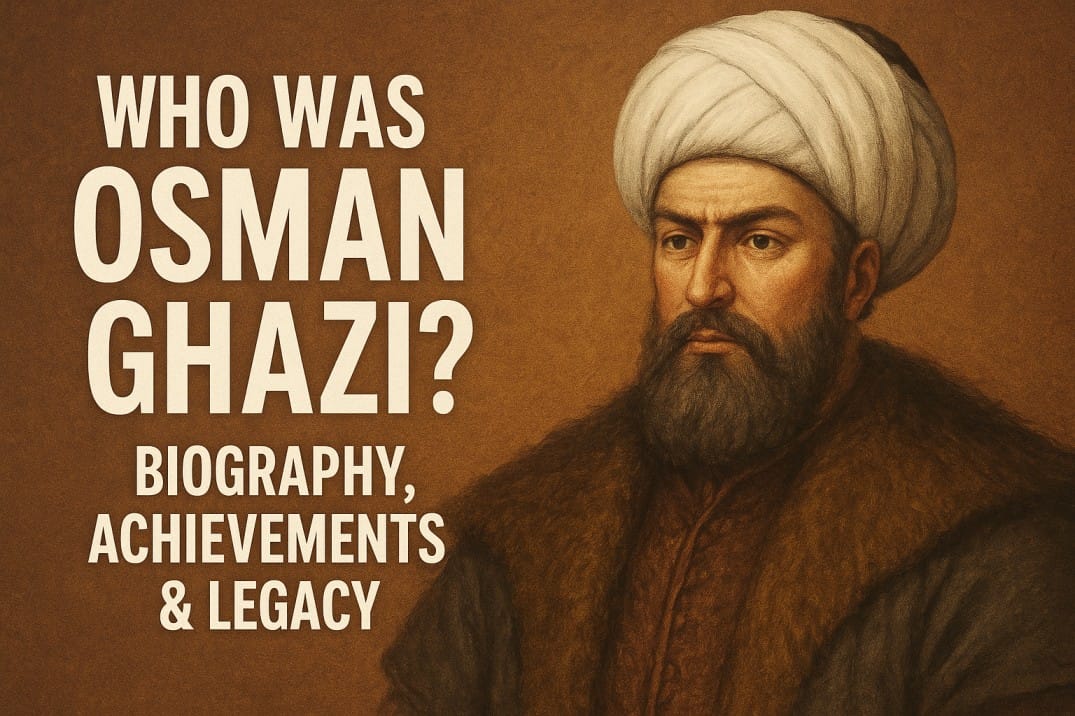
An early modern painting depicting Osman Ghazi (Osman I), the founding leader of the Ottoman Empire, in traditional Ottoman attire (Public Domain). Osman Ghazi (also known as Osman I) was the founding leader of the Ottoman Empire, which started as a small Turkic beylik (principality) in Anatolia and grew into a vast empire spanning three continents. He was born around 1258 in the town of Söğüt in northwestern Anatolia (modern Turkey).
Osman was the son of Ertuğrul, a tribal chief of the Kayı clan who had established a small principality in Sögüt under the Seljuk Turks. As a young man, Osman earned the title “Ghazi,” meaning a warrior for Islam, due to his military prowess against the Byzantine Empire. Despite the humble beginnings of his realm, Osman Ghazi’s leadership and vision set the foundation for one of history’s longest-lasting empires. In this article, we will explore Osman Ghazi’s biography, his key achievements in battle and state-building, and the lasting legacy he left for future generations.
Early Life and Rise to Power
Osman Ghazi grew up at a time of political turmoil in Anatolia. The once-mighty Seljuk Sultanate of Rum was in decline, and the region was divided among many small Turkic principalities (beyliks). Osman’s father, Ertuğrul, had been a loyal ally of the Seljuks and was rewarded with land in Söğüt, on the frontier with the Byzantine Empire.
After Ertuğrul’s death around 1280, Osman inherited the leadership of the Kayı tribe and the Beylik of Sögüt. Young and ambitious, he quickly took on the role of frontier ghazi, leading raids and battles against the neighboring Byzantine forces.
During his early reign, Osman forged important alliances and solidified his authority. A famous Ottoman legend recounts that Osman had a prophetic dream which greatly influenced his life. According to this story, Osman saw a moon rise from the chest of Sheikh Edebali (a respected local Sufi elder) and then a tree sprouting from Osman’s own body, its branches spreading far across the world.
Interpreting this dream as a divine sign that Osman’s lineage would build a great empire, Sheikh Edebali consented to Osman’s marriage with his daughter, Malhun Hatun. This marriage (around 1289) not only gave Osman a wise mentor and father-in-law in Edebali, but also strengthened his support among local tribes and spiritual leaders.
With his authority bolstered, Osman Ghazi set out to expand his tiny territory. By 1299, with the Seljuk state effectively dissolved, Osman is traditionally considered to have established his independence, marking the birth of the Ottoman state. He moved from merely being a frontier chieftain to the ruler of a nascent principality.
Osman made Yenişehir (a town he conquered) his capital, using it as a base for further expansion. Contemporary Byzantine sources and later Ottoman chronicles describe Osman as a skilled leader who was both brave in battle and shrewd in strategy, enabling him to unite other Turkoman warriors under his banner.
Achievements and Military Conquests
Once in power, Osman Ghazi’s achievements were primarily in the realm of military conquest and state-building. He took advantage of the weakening Byzantine Empire, which at the time was struggling to hold on to its territories in Anatolia. Osman’s forces — comprised of ghazi warriors eager to gain booty and glory — waged a slow but determined conflict against local Byzantine lords.
Over the years, Osman gradually captured a number of fortresses and towns along the Byzantine frontier. These included strategic locations such as Bilecik, Yarhisar, and İnegöl, which strengthened his hold on the region and provided springboards for further expansion. Each victory not only expanded Osman’s territory but also attracted more Turkic warriors to join him, drawn by his success and the promise of plunder and land.
One of Osman’s notable early moves was the siege of Nicaea (Iznik) around 1299–1301. Nicaea was a significant walled city and a former Byzantine capital in Anatolia. Osman’s troops blockaded the city in an attempt to take this rich prize.
However, the siege of Nicaea proved too difficult at that time – the city’s strong defenses and a large garrison repelled Osman’s forces, forcing him to withdraw after a couple of years. Despite this setback, Osman’s persistent pressure on Byzantine territories did not let up. His campaigning caught the attention of Byzantine Emperor Andronikos II, who even sought help from outside (including hiring mercenaries) to contain Osman’s rising power.
Osman’s greatest military victory came in 1302 at the Battle of Bapheus (Koyunhisar). In this battle, Osman’s army faced a sizeable Byzantine force near the Sea of Marmara. Osman won a decisive victory, which was a turning point for the Ottomans.
The Battle of Bapheus solidified Ottoman control over the countryside of Northwestern Anatolia, forcing the Byzantines into a defensive stance. After Bapheus, Byzantine influence in Bithynia (Osman’s region) virtually collapsed. Osman’s troops could then overrun surrounding villages and smaller towns with relative ease, further expanding his fledgling state.
Following these successes, Osman Ghazi focused on an even bigger target: the Byzantine city of Bursa (known as Prusa at the time). Bursa was a wealthy city in northwest Anatolia, and capturing it would be a major prize. Around 1308, Osman’s forces managed to encircle Bursa, effectively laying siege to the city.
He captured the smaller fortresses and supply outposts around Bursa, isolating the city from landward support. However, Bursa could still receive aid via its sea connection to Constantinople, and the siege dragged on for years. Osman continued to tighten the noose; by 1321, the last Byzantine-held port in the area had fallen to the Ottomans, cutting off Bursa’s supply lines. The city was now on the brink of capitulation.
It’s important to note that Osman Ghazi’s achievements were not just in battlefield victories, but also in laying down administrative foundations for the new Ottoman state. He began organizing his army and territory following Seljuk Turkish models, since the Seljuks had been the previous Islamic rulers in the region.
Osman adopted their techniques of warfare and governance, and maintained the traditions of ghazi leadership, where leadership was earned through valor and shared loyalty among tribal warriors. He appointed trusted commanders (called uç beys, or frontier chiefs) to govern and defend frontier zones, which helped secure Ottoman borders and allowed for more coordinated expansion.
By the early 1320s, Osman Ghazi had created a stable and expanding mini-kingdom for himself and his people. His achievements can be summed up as follows:
- Founding an Independent State: Osman transformed his father’s small principality into an independent Ottoman state (beylik) by capitalizing on the power vacuum left by the declining Seljuks and Byzantines. By 1299, he was effectively the sovereign of a new realm, laying the cornerstone of the Ottoman Empire.
- Military Victories: He led successful campaigns against local Byzantine lords, seizing key forts and towns. His victory at Bapheus in 1302 crushed Byzantine resistance in northwest Anatolia and opened the path for Ottoman expansion.
- Territorial Expansion: Under Osman, Ottoman territories expanded to include fortresses like Yenişehir, Bilecik, Yarhisar, and İnegöl, establishing Ottoman dominance in the region. Yenişehir became the first Ottoman capital, highlighting Osman’s skill in both conquest and governance.
- Siege of Bursa: Osman initiated the prolonged siege of Bursa, demonstrating strategic patience and foresight. Although he did not live to see Bursa fall, his efforts set the stage for its capture, which would soon make Bursa the first major capital of the Ottoman Empire.
Death and Legacy of Osman Ghazi
Osman Ghazi died around 1323–1324 (some sources say 1326) at an age of roughly 68, after nearly a quarter-century of leading his people. According to tradition, he passed away just before the final fall of Bursa. The task of capturing that great city fell to his son and successor, Orhan Ghazi. In 1326, Orhan successfully took Bursa from the Byzantines, fulfilling Osman’s goal and making Bursa the new Ottoman capital.
Osman had been buried in Söğüt, the town of his birth and first stronghold, but later his remains were reinterred in Bursa when it became the Ottoman capital. Today, Osman Ghazi’s tomb in Bursa is a historic site, and his name lives on in the city’s Osmangazi district.
The legacy of Osman Ghazi is immense considering the modest scale of his own lifetime conquests. Osman’s dynasty — the Ottoman dynasty — continued to build on his foundations, transforming the small beylik he started into a world empire over the next few centuries.
In fact, the very name “Ottoman” is derived from Osman (Ottoman Turkish: Osmanlı), underscoring how the empire saw itself as the continuation of Osman’s lineage. His successors, from Orhan to Süleyman the Magnificent and beyond, expanded the Ottoman Empire across Asia, Europe, and Africa.
The empire Osman founded lasted over 600 years, surviving until 1922, shortly after World War I, when the Ottoman sultanate was finally abolished. This incredible longevity is a testament to the strong foundations laid during Osman’s time.
Osman Ghazi is often remembered in Ottoman history as a just and brave ruler. Later Ottoman writers depicted him as a model leader who valued fairness, piety, and valor. Whether fighting against Byzantine armies or managing relationships with other Turkic tribes, Osman earned a reputation for leadership that inspired loyalty.
One enduring symbol of his legacy is the Sword of Osman – according to tradition, Osman was girded with a special sword by Sheikh Edebali as a sign of investing him with authority and a holy mission. In the centuries that followed, every new Ottoman sultan would be ceremonially girded with the Sword of Osman during their coronation, a ritual reminding them that they were inheriting the warrior spirit and duty of Osman Ghazi. This practice underlined that the Ottoman rulers’ legitimacy stemmed from Osman’s original role as the courageous ghazi who started it all.
Another aspect of Osman’s legacy is the continuity of religious and cultural traditions he fostered. Osman and his followers were Sunni Muslims, and they were influenced by Sufi mentors like Edebali. This spiritual dimension helped shape the character of the Ottoman state. The Ottomans under Osman and his son Orhan were relatively tolerant for their time – they incorporated locals of different faiths into their growing state and allowed a degree of autonomy to conquered towns, a practice that would later blossom into the Ottoman millet system.
While Osman himself ruled a predominantly nomadic, military-oriented society (and thus did not build grand monuments or cities), his son Orhan and later sultans would develop the empire’s administration, architecture, and institutions, turning the Ottomans into a settled civilization. In this way, Osman’s legacy includes not only the lands he conquered but also the early ethos of governance and inclusivity that helped the empire endure.
In summary, Osman Ghazi was the visionary founder of the Ottoman Empire – a man who rose from obscurity to establish a dynasty. His life story, from a tribal bey in Söğüt to the father of an empire, is filled with daring battles, strategic alliances, and legendary tales. His achievements in uniting the Turkic clans and defeating the Byzantines set in motion the creation of an empire that would shape the course of history in Europe and the Middle East for centuries.
The legacy of Osman Ghazi lives on not only in history books and the record of conquests, but also in cultural memory: he is revered as a national hero in Turkey, often celebrated in literature and popular media as the embodiment of the Ottoman spirit. Most importantly, the empire that bore his name – the Ottoman Empire – stands as a lasting monument to Osman Ghazi’s enduring impact, growing from a tiny frontier settlement into one of the most powerful empires the world has ever seen.